
A Portable Paradise: Opening Reflections from the 2026 Skoll World Forum
June 24, 2026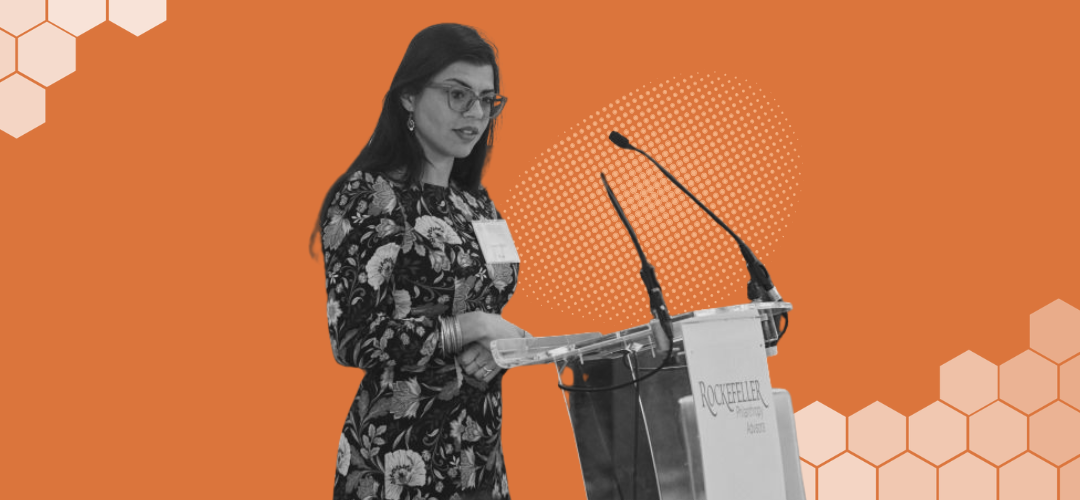
This past May, RPA convened funders at Skoll World Forum to explore the concepts and practical steps that session partners have used to build impactful strategies, forge effective partnerships, and contribute to lasting systems change.
The program opened with welcome remarks from our Co-CEO & President Walter Sweet and poet Josiane Smith, before moderator Heather Grady guided panelists Joshua Amponsem (Youth Climate Justice Fund), Priya Bery (The Pew Charitable Trusts), and Kristy Muir (Paul Ramsay Foundation) through a rich conversation on the leadership required to meet this moment — and build the future we collectively aspire to.
Below are Josiane’s opening remarks.
I’m delighted to be here this morning. I’ll begin with my favourite ever poem called ‘A Portable Paradise’ by Roger Robinson:
“And if I speak of Paradise,
then I’m speaking of my grandmother
who told me to carry it always
on my person, concealed, so
no one else would know but me.
That way they can’t steal it, she’d say.
And if life puts you under pressure,
trace its ridges in your pocket,
smell its piney scent on your handkerchief,
hum its anthem under your breath.
And if your stresses are sustained and daily,
get yourself to an empty room – be it hotel,
hostel or hovel – find a lamp
and empty your paradise onto a desk:
your white sands, green hills, and fresh fish.
Shine the lamp on it, like the fresh hope
of morning, and keep staring at it till you sleep.”
Last year, I wrote a poem for this very breakfast called “Do we have enough faith?” which came from a feeling, I think, many of us were carrying at the time: that to keep on building, making impact, working towards the dream of a better future, we needed to draw on a lot of faith.
Whether we’re aware of it or not, faith holds up many of the most fundamental aspects of our lives. It’s what we put in strangers, neighbours, and experts every day; it’s what we draw on to keep going when we feel fear or grief.
The poem encourages us to look more closely at everything we put our faith into when doing the work that we do:
“faith in the movement
faith in the team
faith in our actions
faith in our dreams
faith in the data
faith in the vote
faith in the science
faith in the lifeboat
faith when it’s urgent
faith when it ends
faith when it’s emerging
faith to start again”
The role of that poem was to show us that while, yes, now is a time that requires a lot of faith, faith already runs through our lives in a million different ways every day.
I’ve been speaking to people over the past few days about when and why they turn to poetry and how it might relate to their work. Last night, my friend and fellow poet, Gannon Gillespie from Catalyst Now, shared a quote by Eleanor Roosevelt, which says:
“Where, after all, do human rights begin? In small places, close to home — so close and so small that they cannot be seen on any map of the world. Yet they are the world of the individual person…”
We both concluded that systems change also begins in small places. That’s not to say it can’t be scaled, ambitious, or ‘catalytic’; rather, that every system begins with what is close to us and is often even reflected within us. It’s almost like poetry enables the inner work needed for systems change. It creates stability and bravery, interconnectedness and imagination, without which the risk of trying to change systems is likely significantly higher.
So poetry de-risks systems change. And not only does it de-risk it, but it often accelerates it, as we’ve seen in the history of social movements over the years.
For example, I am a Quaker, and I’m doing a PhD on the Society’s historical involvement in transatlantic slavery. I focus on how this small group of persecuted, anti-establishment, radical Christians in the 17th century gained wealth and security through colonisation, plantations, and trade. I’m also studying those ‘prophets’ within Quakerism who became abolitionists, exploring what got them to question an accepted reality and wake up to the violence in that system. What made them divest their money and invest it in activities that truly changed a system?
Quaker worship is in silence, and I believe this contributed to their early abolition efforts. Silence, like poetry, is an example of a small place where systems change begins.
From this place, they founded anti-slavery societies, gave paid work and funding for free Black women and men to travel and tell their stories. They wrote pamphlets, made escape possible by harbouring people on the run, became outcasts within their communities because of their radical opinions, spoke to legislators and politicians, made theatre and marched, and did all this for *two hundred years*, until the Emancipation Act in 1833.
The tools that help us into the small places where systems change begins, like poetry, help us to acknowledge and learn to work with our convictions, intuitions, and felt experience… these are all sources of immense power and bravery.
As a philanthropy advisor, for a long time I didn’t think my poetry was relevant to my work, but increasingly I find that poetry is the small place I want my clients to get to, in order to connect with something deeper and bigger than them.
Poetry connects us more to mystery, ambiguity, and emergence, which are inevitable parts of change. Poetry shows us an issue from different perspectives and articulates a viable future that encompasses different voices and experiences. Poetry helps us to release latent, trapped, difficult emotions and, in doing so, helps get ourselves and our systems unstuck. And finally, poetry helps us to find ways to make our work not just tolerable, but also beautiful.
Poetry, like change, happens first in the hearts and minds of real people. It’s a tool that helps different conversations to happen. I don’t just mean finding a poem that resonates or writing one. I also mean a kind of poetics, carrying a posture that listens and asks questions and crafts a narrative that connects the deeply personal with the universal.
I love Robinson’s poem, ‘A Portable Paradise’ because it speaks to the importance of a vibrant inner world, in the face of external pressures and change, and shows us what it means to keep working towards the world we want, again and again and again. And that takes a lot of faith. Even though that might be small, it’s where I believe all systems change begins.
Back to News